
Commercial Waste Wembley: Recycling and Sustainability
At Commercial Waste Wembley we are committed to establishing an eco-friendly waste disposal area that supports local businesses, reduces landfill and creates a measurable route to net-zero. Our sustainable approach to managing commercial waste in Wembley balances practical collections with long-term environmental goals. We work across retail, hospitality and light industrial sectors to create dedicated sustainable rubbish areas on-site, clear signage for waste separation and tailored collection schedules that reduce vehicle movements and emissions.Our sustainability framework sets a clear recycling percentage target: we aim for a minimum 70% recycling rate across client waste streams by 2030. This target is rooted in rigorous waste audits, improved segregation at source and increased reuse pathways for furniture, appliances and construction materials. We track progress month-to-month and share anonymised performance metrics so businesses in Wembley and neighbouring boroughs can benchmark improvements and celebrate lower-carbon operations.

Practical separation and borough collaboration
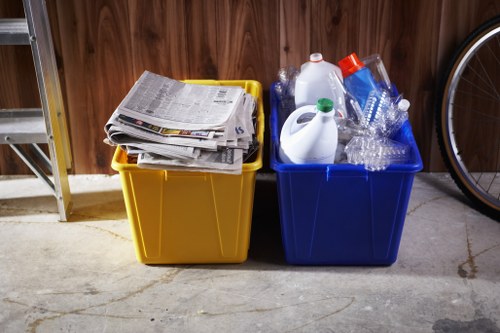
Across Brent and surrounding boroughs the emphasis is on separating food waste, dry mixed recycling, glass and textiles at the point of generation. Our local teams advise on layout for a sustainable rubbish area that supports operational flows — for example:- Separate bins for food/organic waste to capture material for anaerobic digestion
- Clear containers for paper/cardboard and commingled plastics
- Secure skips for reusable furniture and WEEE (electricals) destined for refurbishment
Partnerships with local charities are central to our reuse strategy. We maintain regular collections with charities that accept donated office furniture, textiles and small electrical items, ensuring items get a second life in the community rather than being incinerated or sent to landfill. These collaborations form a core part of our Wembley commercial waste offer: streamlined collection, transparent documentation and measurable social value outcomes, such as supporting apprenticeship or reskilling programmes run by partners.

Transfer stations and low-carbon logistics
The logistics behind an effective commercial waste operation matter. We route collections through accredited local transfer stations to minimise double-handling and reduce haul distances. Our network includes transfer points that support segregation, baling and onward transport to material recovery facilities or specialist recyclers. To lower emissions further we operate a growing fleet of low-carbon vans and electric-assisted vehicles for last-mile pickups; these vehicles reduce diesel mileage and are integrated into optimised route planning to cut total kilometres driven.Waste segregation and transfer are supported by on-site training: our operatives and client staff receive clear guidance on maintaining a robust eco-friendly waste disposal area. We use waste audits to identify contamination hotspots, then implement corrective measures such as lockable containers for confidential waste, and dedicated drop-off points for hazardous items like batteries and fluorescent tubes, ensuring compliance with hazardous waste regulations and safeguarding recycling quality.
Construction and refurbishment projects in Wembley often generate mixed streams: inert rubble, timber, metal and mixed recyclables. Our construction-focused services ensure materials are separated at source and directed to appropriate recycling channels. For office-based clients, we provide secure document destruction alongside a recycling pathway for shredded paper and card. By creating a clearly labelled, accessible and monitored sustainable rubbish area, businesses reduce contamination, improve recycling yields and help reach the 70% recycling target.
 We also maintain strong relationships with specialist recyclers who process materials that conventional MRFs (materials recovery facilities) cannot handle. Examples include mattress recycling, pallet reuse schemes and diversion of cooking oils for biofuel production. These options create additional circular economy pathways for Wembley companies and reduce reliance on disposal, supporting a holistic approach to Wembley commercial waste management that prizes reuse and resource recovery.
 In summary, our sustainable approach to commercial waste in Wembley combines ambitious targets with practical delivery: on-site segregation, partnerships with charities for reuse, efficient routing via local transfer stations and low-carbon vans to lower emissions. We provide tailored advice to create effective waste zones, help clients meet local borough expectations on separation and deliver measurable performance against our recycling percentage target. This integrated model creates healthier local environments, reduces operational costs and supports a greener future for businesses across Wembley and the surrounding boroughs.
